How to Write a Love Storybook in Romantic Style
To write a love storybook in romantic style, build relatable characters, give their relationship a clear arc of tension and growth, and tell it through vivid, emotional language that makes readers feel the love rather than just read about it. The romantic style lives in the small, true details — a held glance, a fear finally spoken aloud, a place that means everything to two people.

Whether you're writing about your own relationship or inventing one, this guide walks you through the romantic style step by step: defining its key elements, building characters and plot, layering in romantic language, and shaping a climax and resolution that land. You'll also find ways to draw on your real relationship so the story feels authentically yours.
TL;DR: How to Write a Love Storybook in Romantic Style
- Lead with emotion. Romantic style prioritizes feeling, vulnerability, and inner experience over plot mechanics.
- Build two characters worth rooting for, then give their relationship a real obstacle — love is most moving when it's tested.
- Show, don't summarize. Use vivid imagery, metaphor, and sensory detail to make scenes immersive.
- Anchor it in truth. Drawing on real memories, milestones, and inside jokes is what makes a love story unforgettable — and 2024 research links personalized stories to stronger emotional bonds.
- End with earned resolution. The climax should force a choice; the ending should reward the characters' growth.
What Is Romantic Style in Writing?
Romantic style is a way of writing that emphasizes emotion, passion, and the inner lives of characters over action or plot mechanics. It favors heightened feeling, sensory beauty, and the transformative power of love, often through grand gestures, intimate moments, and rich descriptive language.
In a love storybook, romantic style means your goal isn't just to tell readers that two people fell in love — it's to make them feel the pull, the ache, and the joy of it themselves. Classic examples like Jane Austen's Pride and Prejudice and Emily Brontë's Wuthering Heights show the style at full strength: intense emotion, complex characters, and love that changes everyone it touches.
Every romantic love story leans on four core elements. Weave all four through your storybook and the romantic tone takes care of itself.
The 4 Key Elements of Romantic Style
| Element | What it does | How to use it |
|---|---|---|
| Emotional depth | Lets readers connect with the characters | Show inner thoughts, fears, and longing, not just events |
| Vivid imagery | Makes scenes immersive and sensory | Describe light, touch, sound, and setting in detail |
| Symbolism | Gives love a physical anchor | Recurring objects — a letter, a flower, a place |
| Conflict & resolution | Tests the love and makes it earned | Introduce a real obstacle, then resolve it through growth |
Personalized, true-to-life stories carry the most weight. A 2024 University of Bath study found that personalized gifts and keepsakes create stronger, longer-lasting emotional connections than generic ones (ScienceDaily, 2024) — the same principle that makes a love story built on real memories far more moving than an invented one.
Step-by-Step Guide to Writing a Love Storybook in Romantic Style
Follow these five steps in order to take your love storybook from blank page to finished keepsake.
Step 1: Develop Your Characters
Start with two characters readers can root for. Give each a distinct personality, a background, and a clear set of motivations — then decide how their pasts shaped the way they love. The friction between two different worldviews is the engine of a romantic story.
Define the relationship early: are they childhood friends, star-crossed lovers, or unlikely opposites? That dynamic guides everything that follows.
Example: Emma and Liam meet in college and click instantly. Emma is a free spirit who believes in love at first sight; Liam is cautious and pragmatic. Their opposing views on love create the tension — and the growth — that carries the whole story.
Step 2: Craft a Compelling Plot
Give your story a clear arc with a beginning, middle, and end, and let the relationship evolve across it. The plot of a romantic story is really the story of how a bond is built, tested, and ultimately proven.
Then introduce conflict. The most powerful obstacles are either external (distance, family, society) or internal (fear of vulnerability, past heartbreak) — and the best stories use both.
Example: Emma and Liam's relationship is tested when Emma is offered a job abroad. The conflict comes from clashing priorities and a shared fear of long-distance love.
Step 3: Use Romantic Language and Imagery
Romantic style lives in the language, so describe settings, emotions, and physical sensations in rich, sensory detail. Don't tell readers a moment was beautiful — let them feel the warmth, hear the quiet, and notice the held breath.
Reach for metaphor and simile to deepen the feeling. Comparing love to the ocean, a slow sunrise, or a blossoming flower gives an abstract emotion something concrete to hold.
Example: For Emma and Liam's sunset picnic, write the gold of the light on her face, the breeze lifting the edge of the blanket, the way their voices drop to almost nothing as the sky turns.
Step 4: Focus on Emotional Development
Let your characters change. A romantic story is most satisfying when love teaches the characters something — about themselves, each other, or what they're willing to risk. Show that growth in their choices, not just their words.
Lean into vulnerability. The moments where a character admits a fear or a hope are where intimacy is built, both between the characters and with the reader.
Example: As Emma and Liam navigate distance, they learn to speak openly about their fears and dreams — and that honesty is what finally bonds them.
Step 5: Create a Memorable Climax and Resolution
Build tension toward a single climactic moment where the characters must face their deepest fear and make a real choice. The climax should feel inevitable yet uncertain — readers should not be sure love will win until it does.
Then resolve the story in a way that reflects how far the characters have come. A reunion, a commitment, or a quiet new understanding all work, as long as the ending is earned.
Example: At the climax, Emma chooses a future with Liam beside her. The resolution celebrates their growth and the commitment they've built together.
How to Draw on Your Real Relationship
The most moving love storybooks borrow from real life. If you're writing about your own relationship, mine your shared history for material: the moment you met, the first argument you laughed about later, the small rituals only the two of you understand. Authentic detail is impossible to fake and impossible to forget.
A few ways to bring real intimacy onto the page:
- Practice active listening with your partner and notice the phrases and stories they return to — those are your scenes.
- Express vulnerability in the writing the way you would in the relationship; share the fears and dreams that made the love real.
- Celebrate milestones — anniversaries, hard seasons survived, quiet wins — as chapter beats.
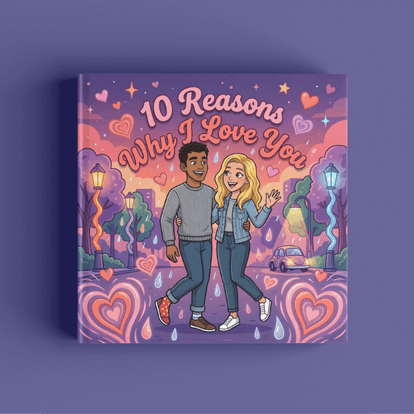
For a deeply personal touch, dedicate a chapter to all the reasons why I love you. A running list of specific, true reasons is often the chapter readers — and partners — remember most.
Common Mistakes to Avoid
Steer clear of these pitfalls and your romantic story will read as heartfelt instead of generic.
- Predictable plots. If readers can guess every beat, the tension disappears. Add an unexpected obstacle or twist.
- One-dimensional characters. Flawless lovers are boring. Give characters real flaws, contradictions, and growth arcs.
- Telling instead of feeling. "They were in love" is flat. Show it through action, detail, and vulnerability.
- All idealism, no realism. Pure fantasy rings hollow. Balance the sweeping moments with honest, everyday ones.
- Inconsistent characters. Keep a short profile for each character so their voice and choices stay true throughout.
- Saving it for the perfect mood. Writer's block thrives on waiting. Set a small daily writing window and protect it.
Conclusion: Turn Your Love Into a Story Worth Keeping
Writing a love storybook in romantic style is, at heart, an act of paying attention — to emotion, to detail, and to the truth of a relationship. Build characters readers care about, give their love a real test, write in vivid and vulnerable language, and end on growth, and you'll have a story that moves people and deepens your own connection in the process.
Embrace the process, draw on what's real, and let your emotions guide the page. Once your draft feels right, a personalized love story book turns your words into a bound keepsake worthy of the romance.
Frequently Asked Questions
Common questions about relationship guides
What are the essential elements of a romantic love storybook?
How can I develop strong characters for my love storybook?
What role does setting play in a romantic love storybook?
How can I ensure my love storybook evokes deep emotions?



Still have questions?
Can't find the answer you're looking for? Get in touch with our support team.
We've helped 2,356+ couples make someone's day
More about Guides about Couples and personalized gifts
Every love story deserves its own book
Discover our collection of personalized, illustrated books that turn your relationship into a premium keepsake. AI writes, you keep the memories.